Stone Remnant Tracking Software: How to Track, Nest, and Monetize Slab Offcuts
In an average stone fabrication shop, between $30,000 and $60,000 worth of premium quartz, marble, and granite offcuts sit forgotten outside in A-frame racks—decaying in the weather while estimators order brand-new wholesale slabs for small bathroom vanities.
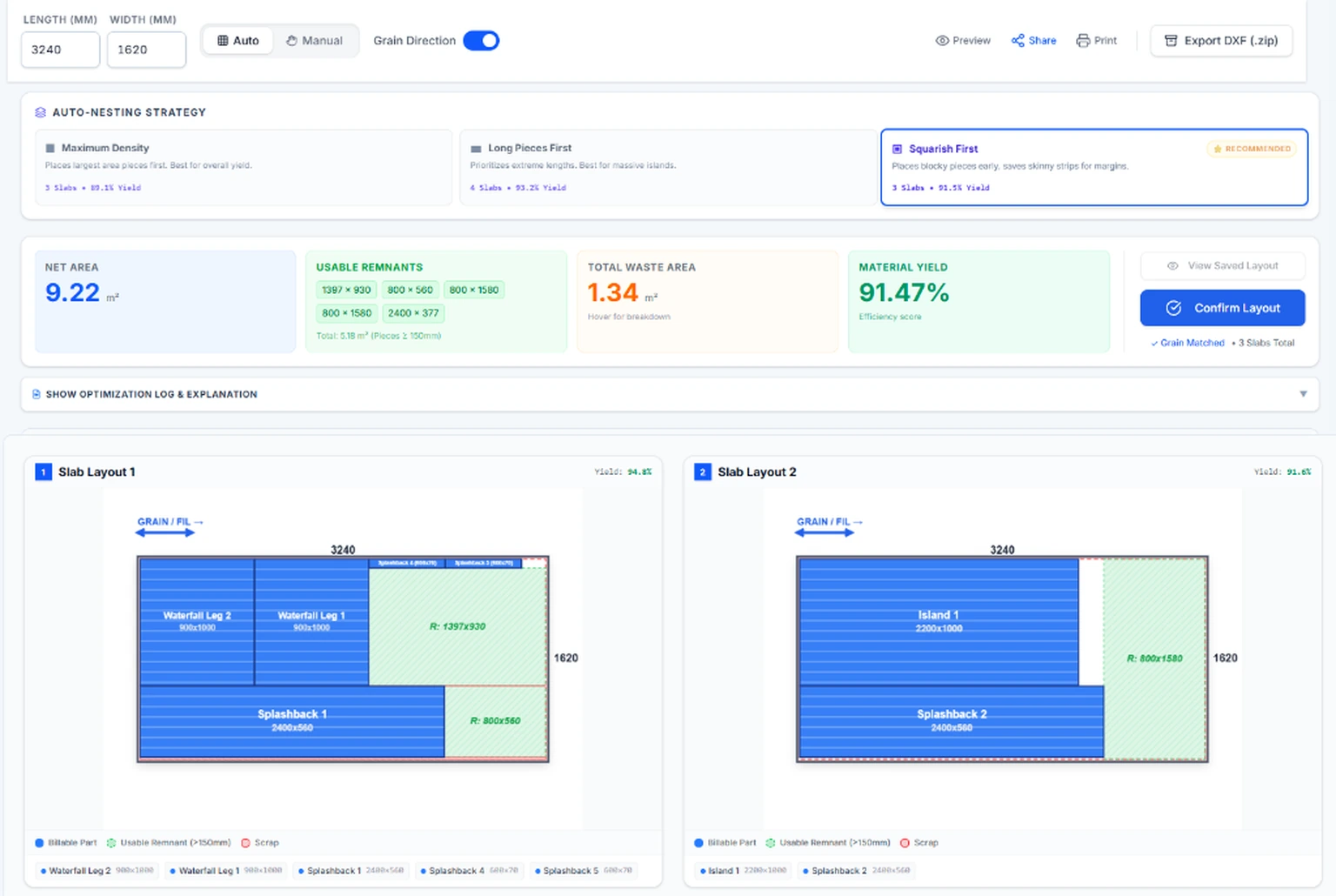
1. The "Remnant Graveyard": Where Shop Profit Margins Go to Die
Walk into nearly any independent stone countertop shop and you will find the same scene out back: hundreds of jagged pieces of natural quartzite, engineered quartz, and granite leaning against rusty outdoor A-frames. Chalk dimensions scrawled on them two years ago have washed away in the rain. Weeds grow between them.
Every one of those offcuts was paid for in full when the primary kitchen countertop was fabricated. Yet, because the shop lacks real-time stone remnant tracking software, front-desk estimators have zero visibility into what stone exists outside.
When a builder orders a 60-inch vanity in Taj Mahal quartzite, the estimator cannot afford to spend 45 minutes walking the yard with a tape measure. Instead, they pick up the phone and order another $2,400 jumbo slab from the distributor. The customer gets their vanity, but the shop consumes working capital, clutters the yard, and forfeits 70% of the project's potential gross profit.
2. Automatic Bounding Box Offcut Calculation
The central flaw in traditional fabrication software is that remnant logging requires manual data entry. Operators must measure remaining corners with a tape measure, write down numbers on a clipboard, and hope someone manually keys them into an Excel spreadsheet. In practice, busy saw operators skip this step 90% of the time.
StoneHub automates this entirely at the geometric nesting level. As pieces are packed onto a slab—whether through the multi-heuristic nesting engine or our interactive drag-and-drop studio—the system computes all contiguous unallocated rectangular space in real time.
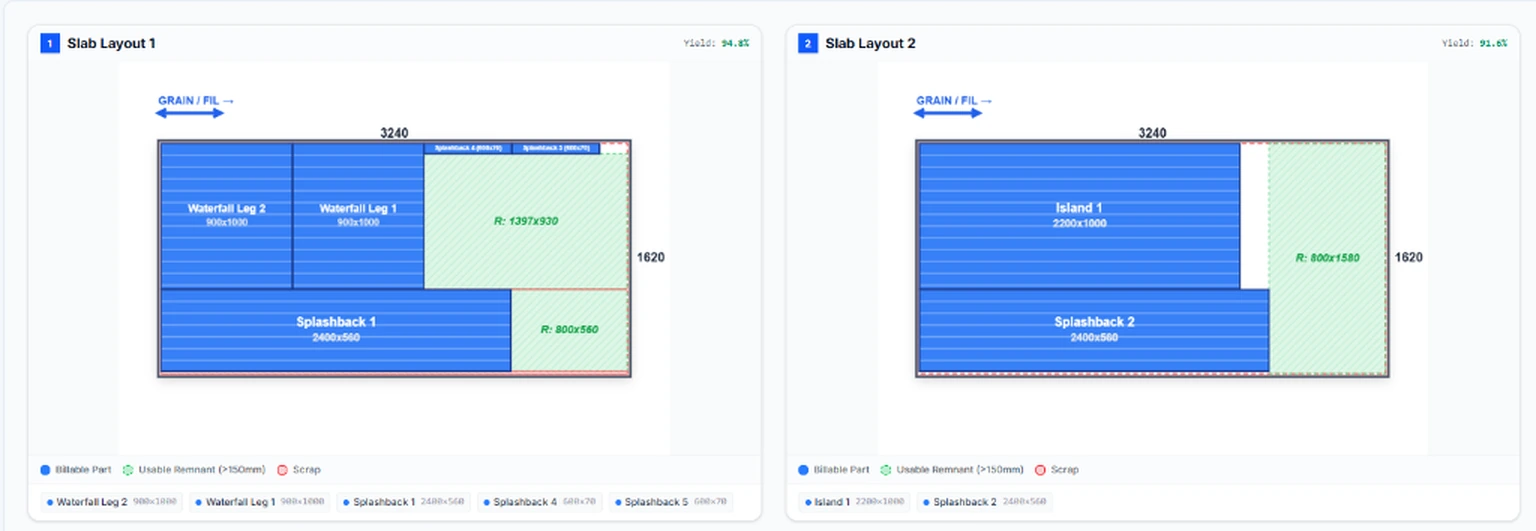
As shown in Figure 2, the nesting engine isolates clean orthogonal bounding boxes while deducting diamond blade kerf offsets (typically 3.2mm to 4.5mm) and rough quarry edge trims. Strips under 150mm are flagged as scrap, while sections exceeding 150mm are calculated as high-value usable inventory.
To see how blade width affects both nesting yields and vein alignment across 45-degree miter joints, read our companion analysis: Vein Matching Software for Mitered Waterfall Islands.
3. Atomic Inventory Capture & Bay Location Tracking
Knowing an offcut exists is useless if your crew cannot find it on the shop floor. True remnant monetization requires linking digital dimensions to physical shop locations.
When a drafter confirms a layout in StoneHub, the platform intercepts the workflow with an Atomic Remnant Confirmation Modal:
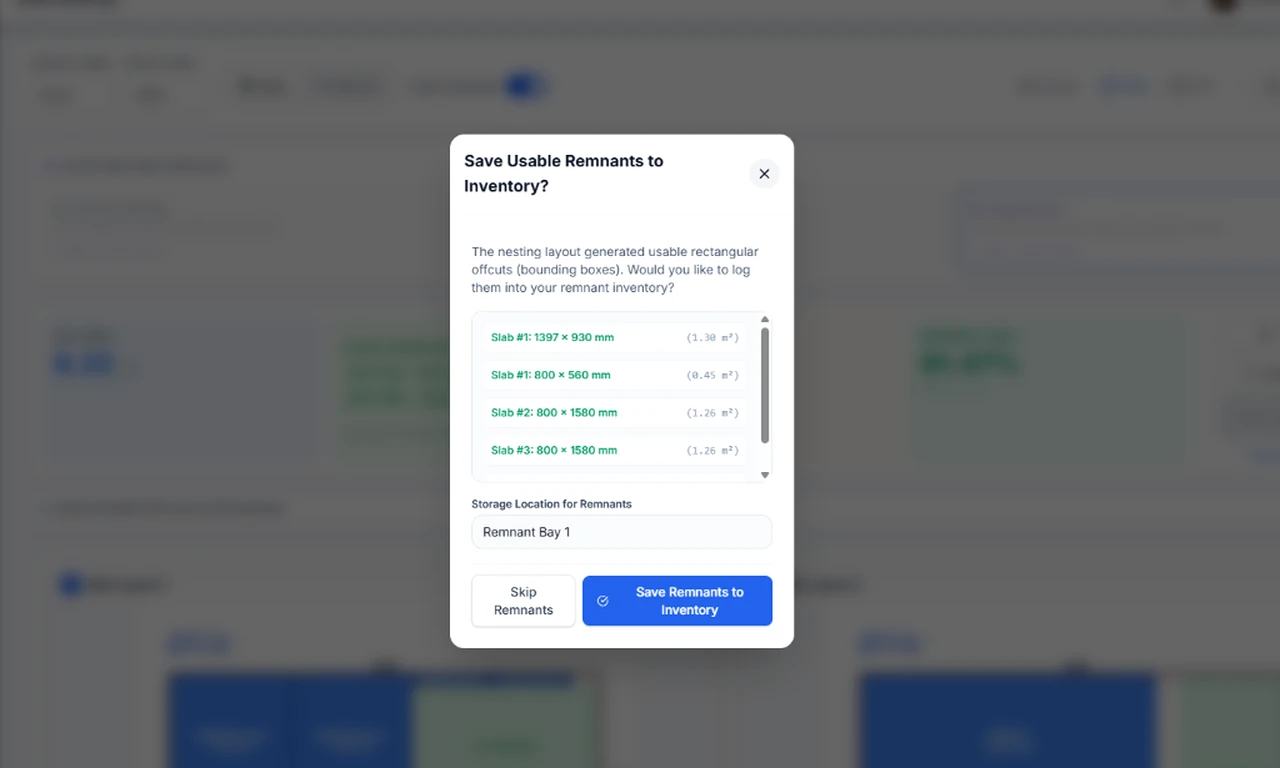
With a single click on "Save Remnants to Inventory", four things happen simultaneously in the database:
- Stock Deduction: The consumed parent slab is deducted from active wholesale stock.
- Remnant Creation: Individual records are created in
inventory_remnantswith exact millimeter dimensions ($L \times W$), thickness, and surface area ($m^2$). - Physical Location Tagging: The pieces are assigned to designated storage zones (e.g., Remnant Bay 1, A-Frame 4, or Indoor Rack C).
- Real-Time Search Availability: The offcuts immediately appear in front-desk quoting and nesting search bars across the entire shop network.
4. The Live Cloud Remnant Catalog: 1-Click Job Allocation
Once remnants are cataloged, sales estimators can monetize them instantly during customer consultations. Instead of quoting small vanity jobs based on full-slab purchases, sales reps open the material catalog directly in front of the homeowner.
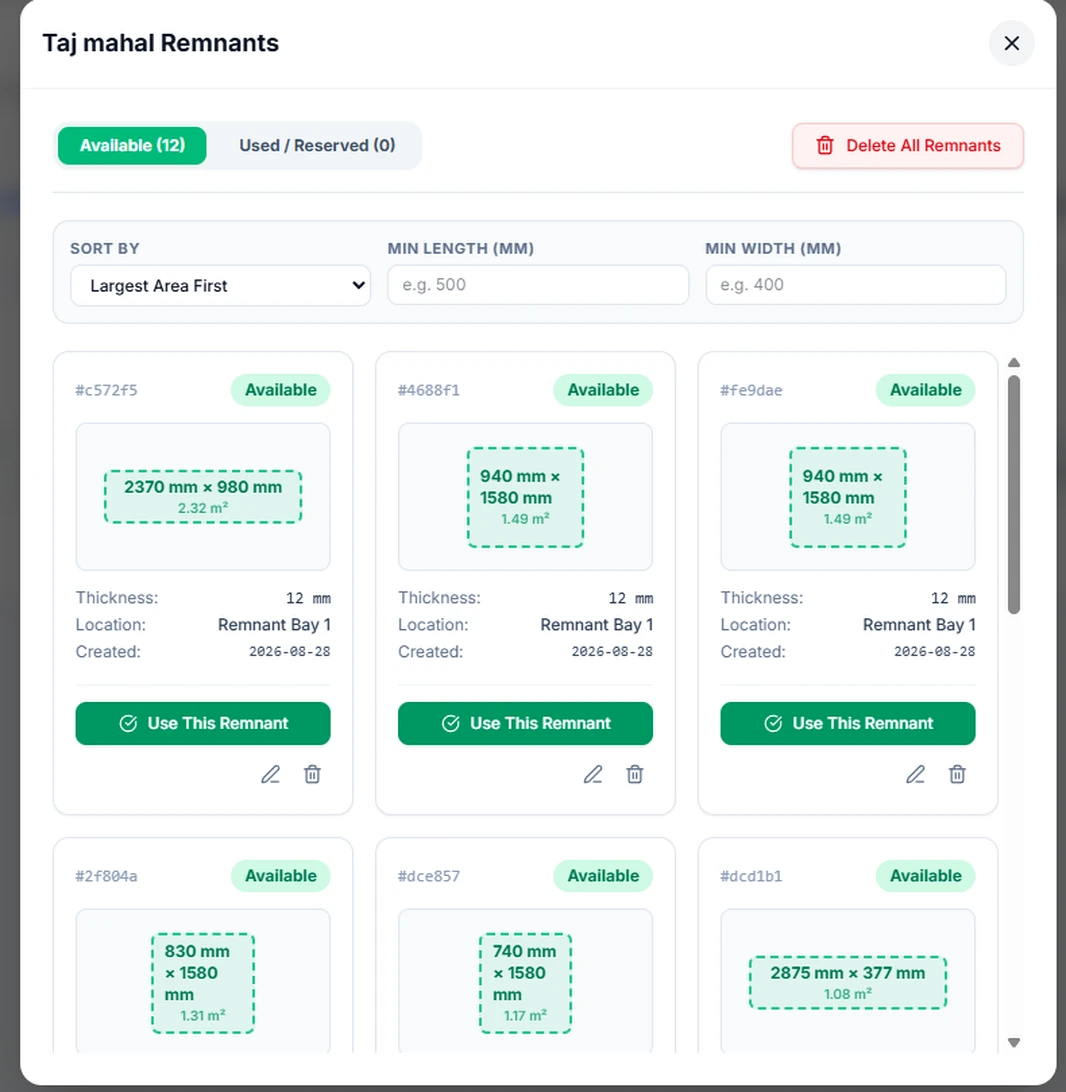
As shown in Figure 4, each remnant card displays a proportional boundary box, square meterage (2.32 m², 1.49 m²), thickness specification (12mm, 20mm, or 30mm), creation date, and rack location.
Clicking [✓ Use This Remnant] pulls the offcut directly into the active CAD layout canvas. The bridge saw nesting algorithm treats the remnant as a custom-sized slab bed, letting the operator place vanity tops, laundry runs, or window sills with automatic kerf spacing and perimeter lead-ins.
5. Manual Yard Scrap vs. Digital Cloud Remnant Nesting
Compare how traditional shop-floor scrap handling compares to automated digital remnant tracking:
| Feature / Metric | Manual Yard Scrap | StoneHub Digital Remnant Tracking |
|---|---|---|
| Offcut Capture Workflow | Manual tape measure & chalk marks (often skipped) | 100% automated algorithmic bounding box calculation |
| Inventory Visibility | Requires walking the outdoor yard (30–60 min) | Instant cloud search by material, thickness & dimension |
| Small Job Gross Margin | 30%–45% (eroded by ordering new full slabs) | 80%–95% (raw material COGS already paid for) |
| Material Degradation | High (weathering, resin fade, micro-cracks) | Near zero (offcuts remelt into production within 30 days) |
| CNC Saw Hand-Off | Operator manually jogs blade and guesses margins | Direct DXF export with origin datum and kerf offsets |
| Rack Location Tracking | Unorganized piles, lost pieces, safety hazards | Exact physical bay assignment (e.g., "Remnant Bay 1") |
6. Monetizing Offcuts: How to Turn Zero-COGS Stone into Cash Flow
In stone shop accounting, when a customer contracts for an L-shaped kitchen countertop requiring two $2,000 quartz slabs ($4,000 total material), the quote price already incorporates the wholesale cost of both slabs.
The 1.49 m² offcut remaining from Slab 2 has a balance-sheet cost of $0.00. When a secondary customer comes in needing a powder room vanity, standard shops offer one of two bad options:
The shop quotes $2,500 for a 48-inch vanity to cover buying a third jumbo slab. The homeowner balks at the high price tag and buys an IKEA prefab vanity instead.
The estimator remembers an old scrap piece outside and charges $250 just to get rid of it, failing to recover edge profiling, machine time, or delivery costs.
With StoneHub's countertop ROI & yield calculations, shops adopt a high-margin middle ground: quote the vanity at competitive market rates (e.g., $950 for stone, edge profiling, and sink cutout). Because the material COGS is zero, the shop nets an immediate $750 to $850 in pure gross profit on a 45-minute saw cut.
Fabrication shops that systematically track and nest offcuts report an average $3,200 to $7,800 monthly increase in net cash flow purely from monetized remnant jobs.
Frequently Asked Questions: Stone Remnant Tracking & Nesting
How to Choose Stone Slab Layout Software for Bridge Saws →
Learn how universal DXF compatibility, blade kerf offsets, and multi-slab auto-nesting prevent costly shop-floor cutting errors.
Stop Leaving $40,000 in Usable Stone Scrap Outside in the Rain
Automatically calculate remnant bounding boxes, track storage bay locations, and nest small jobs with StoneHub. Start your free 14-day trial today.
Instant access • No credit card required • Full remnant inventory & bridge saw DXF export